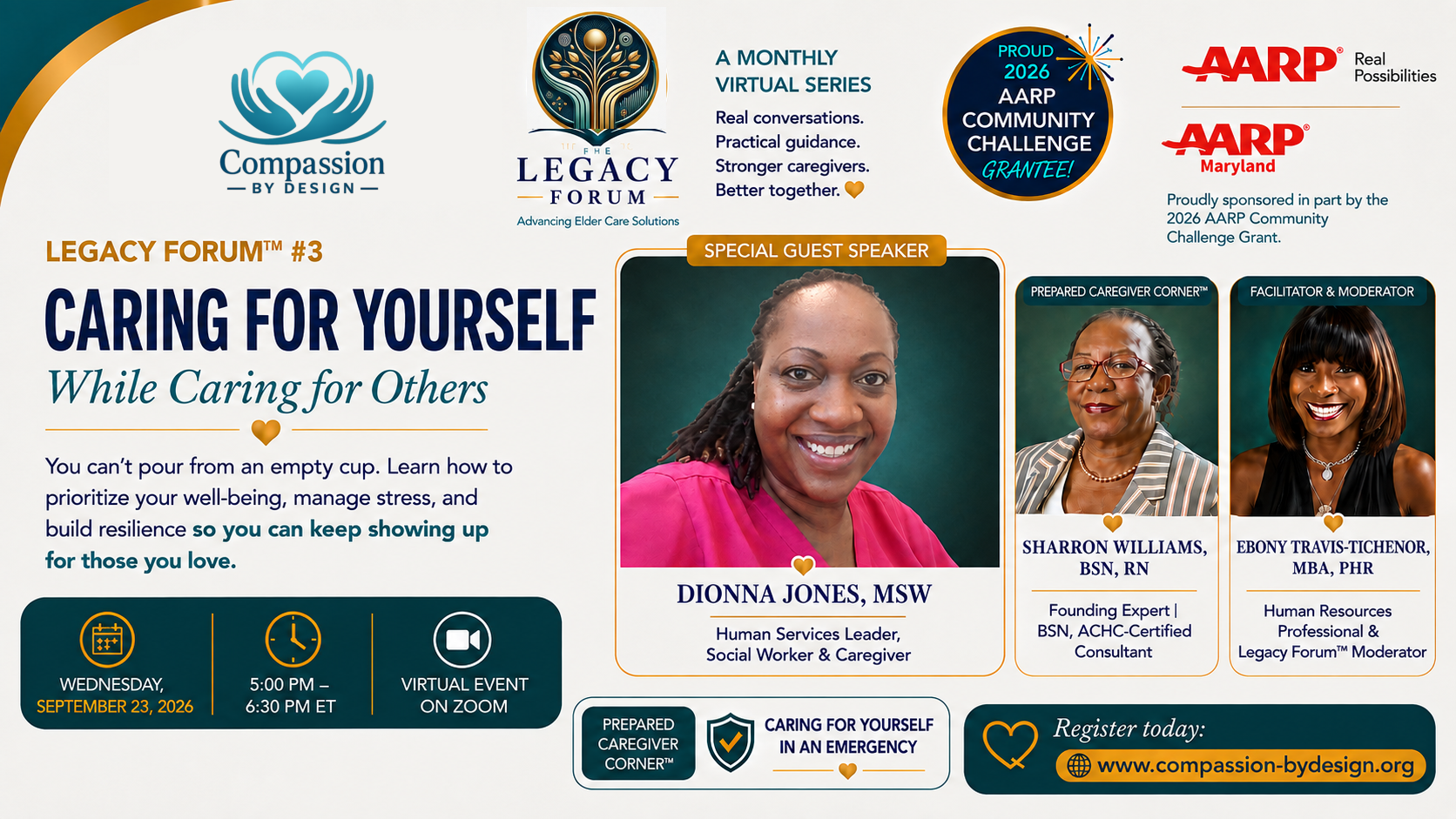
Caring for Yourself While Caring for Others
Who is taking care of you?
September 23, 2026 • Virtual • Compassion by Design, Inc.
Making Room for the Caregiver
Caregiving asks a great deal of people. Legacy Forum #3 made room for a necessary question: Who is taking care of you? Together, we explored practical ways to recognize stress, protect capacity, establish healthy boundaries, ask for support, and make self-care part of the caregiving journey.
The Evening at a Glance
Welcome & Conversation
Host and moderator, welcoming participants and guiding the conversation around caregiving, boundaries, support, planning, and advocacy.
Featured Presentation
An engaging discussion about caregiver stress, self-care, boundaries, asking for help, and creating realistic, recurring practices that protect caregiver well-being.
Prepared Caregiver Corner™
Treceia Bazemore introduced emergency-preparedness resources recommended by Sharron Williams, BSN, RN, focusing on emergency kits and individualized planning.
What We Learned
Recognize stress before you reach depletion.
Exhaustion, disrupted sleep, headaches, irritability, low energy, reduced effectiveness, and simply going through the motions can be signs that a caregiver is carrying too much. Paying attention to those signals creates an opportunity to respond earlier.
Boundaries protect your capacity.
Before automatically saying yes, caregivers can pause and consider what they can realistically sustain. Boundaries help protect the time, energy, and capacity needed for both caregiving and personal well-being.
Ask for specific help.
General offers of help become more useful when caregivers can identify a concrete need. Support might mean providing care coverage, preparing a meal, handling an errand, making a phone call, or simply creating space for the caregiver to rest.
Build self-care into your routine.
Self-care does not have to be a special occasion. Hydration, meals, movement, rest, supportive relationships, personal activities, and regular reflection can become part of daily, weekly, monthly, and longer-term routines.
Caregivers are also advocates.
Preparation, informed questions, clear communication, and understanding the needs of the person receiving care can help caregivers serve as stronger partners and advocates in healthcare settings.
“Boundaries are not barriers. They’re just guardrails.”
— Dionna Jones, MSWPreparedness Is Part of Caring
Legacy Forum #3 continued the Prepared Caregiver Corner™ with resources focused on building an emergency kit and creating an individualized emergency plan.
Caregivers were encouraged to consider essential supplies, medications, important documents, personal support networks, and the individual needs of the person receiving care when preparing for an emergency.
The emergency-preparedness resources shared during the Forum were recommended by Sharron Williams, BSN, RN, Prepared Caregiver Corner™ expert.
Make Room for You
Watch Legacy Forum #3
Watch the full conversation on caregiver self-care, boundaries, support, advocacy, and preparedness. Revisit the discussion at your own pace or share it with a caregiver, family member, friend, or professional who may benefit.
Continue With the Resources
Continue your caregiving journey with practical tools, planning guides, emergency-preparedness resources, and printable materials available through the Golden Circle of Care Hub.
Prepared Caregiver Corner™ is supported by the 2026 AARP Community Challenge, with gratitude to AARP and AARP Maryland for supporting caregiver education, emergency preparedness, and community resilience.
Choose One Step That Makes Room for You
Self-care does not have to begin with a major change. It can begin with a phone call, a request for help, a kept appointment, a few minutes outside, a meal, a moment of rest, or a boundary that protects your capacity.
No matter how big or how small it is, that step counts.
Designing Care with Heart. Creating Change with Purpose.